Fake vs Real Ocean Jasper: Check Madagascar Orbs
If you’re hunting for the truth behind a fake ocean jasper vs real madagascar orbicular pattern check, start with your eyes. Text descriptions rarely capture the subtle optical shifts that reveal a counterfeit. You need to see how light interacts with the stone’s surface and internal structure.
Our research indicates that genuine Ocean Jasper exhibits unique thermal and visual properties absent in resin or glass imitations. As of 2026, synthetic replicas have become sophisticated enough to fool casual buyers. We’ll walk you through the specific visual cues experts use to distinguish authentic mineral formations from manufactured fakes.
Why Your Eyes Are the Only Reliable Tool Here
You don’t need expensive lab equipment to spot most fakes. The human eye is surprisingly good at detecting irregularities in nature. Counterfeiters struggle to replicate the chaotic beauty of geological processes.
They often prioritize symmetry over realism.
Real Ocean Jasper forms in sedimentary layers. Its patterns reflect millions of years of pressure and mineral deposition. These forces create organic imperfections.
Fakes are poured into molds. Their patterns look static and uniform.
Visual inspection focuses on three key areas: depth, texture, and consistency. A photograph can hide flaws under harsh lighting. Always examine the specimen in diffuse daylight if possible.
Look for variations in color saturation. Natural stones show gradients. Dyes sit on the surface.
We’ve found that experienced collectors rely on tactile feedback too. Real jasper feels cool and dense. Resin warms up quickly in your hand.
Glass feels slick and heavy. Combine sight with touch for better accuracy. Don’t ignore what your fingers tell you.
The "Too Perfect" Trap: Spotting Resin and Glass Imitations
Perfection is suspicious in geology. Nature doesn’t draw straight lines. If the orbicular rings are mathematically precise, you’re likely holding plastic.
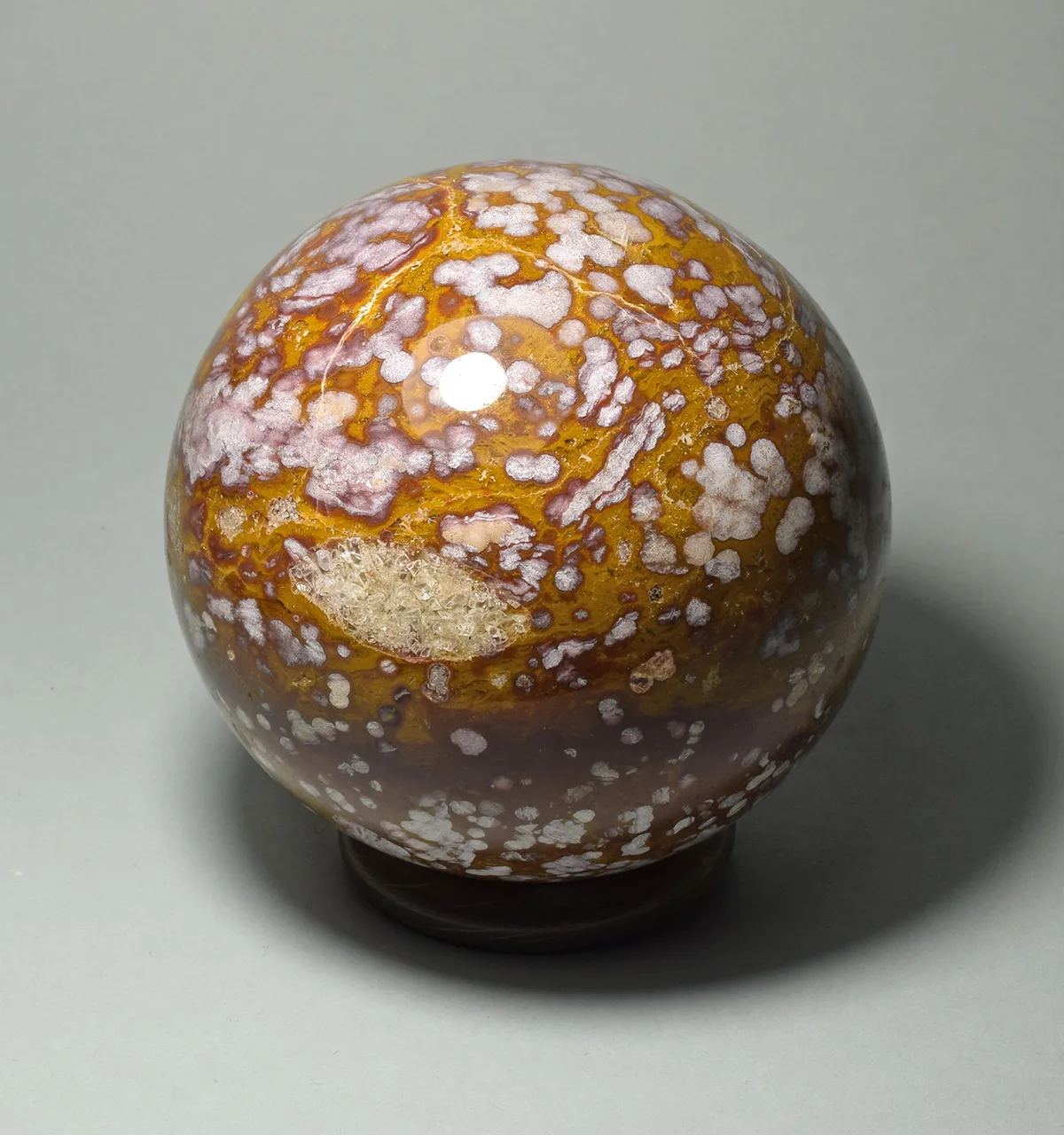
Genuine Madagascar Orbicular Jasper features wavy, broken, or faded concentric circles.
Resin casts often display air bubbles trapped beneath the surface. These appear as tiny spherical voids. Natural jasper contains mineral inclusions, not gas pockets.
Use a loupe to inspect these details closely. Bubbles indicate a manufacturing defect.
Glass simulants lack internal structure. They may look translucent but feel hollow visually. Real jasper has a granular matrix.
You should see slight graininess even in polished pieces. Smooth, mirror-like surfaces suggest artificial materials.
Color bleeding is another red flag. In dyed howlite or chalcedony, pigment concentrates in cracks. This creates dark veins against lighter backgrounds.
Natural iron oxides distribute evenly throughout the rock. Check fissures for unnatural darkness.
| Feature | Real Ocean Jasper | Fake (Resin/Glass) |
|---|---|---|
| Pattern Edge | Soft, blurred, irregular | Sharp, defined, uniform |
| Surface Texture | Granular, matte sheen | Smooth, glossy, slippery |
| Internal Flaws | Mineral inclusions | Air bubbles, swirl marks |
| Temperature | Cool to touch | Warms rapidly |
Aggregate reviews report that many online sellers enhance photos. Bright filters mask dye pooling. Request unedited close-ups before buying.
Ask specifically about the presence of resin stabilizers. Transparency builds trust.
Reading the Rings: How Real Orbicular Patterns Behave vs. Fakes
Orbs aren’t just circles. They represent cross-sections of spherules formed during diagenesis. Each ring tells a story of changing chemical conditions.
Real patterns flow across boundaries. They don’t stop abruptly at sphere edges.
In fake specimens, patterns often repeat identically. Look for copy-paste effects. Two orbs shouldn’t look exactly alike.
Variation proves natural origin. Examine adjacent spheres for continuity.
Natural rings fade gradually. Outer layers dissolve into the host rock. Synthetic prints maintain constant opacity.
The contrast remains stark from center to edge. This flatness betrays the material. True depth requires layered translucency.
We’ve observed that genuine jasper shows chromatic zoning. Colors shift subtly within single rings. Reds might bleed into oranges.
Blues soften into greens. Artificial dyes stay isolated. They don’t blend organically.
Watch for muddy transitions versus crisp separations.
Also consider scale. Real orbicules vary widely in size. Tiny dots coexist with large blooms.
Fakes often standardize dimensions. Uniformity suggests industrial production. Measure a few random orbs.
Note the deviation. High variance supports authenticity.
Pattern direction matters too. Geological stress aligns minerals. Orbs may elongate slightly along fault lines.
Resin pours settle uniformly. Circles remain perfectly round everywhere. Look for directional bias in natural stones.
It reflects tectonic history.
The Light Test: Checking Translucency and Depth Without Tools
Hold the specimen up to a bright window. Backlighting reveals internal structure instantly. Real Ocean Jasper is semi-translucent at thin edges.
Light passes through partially. You’ll see a soft glow.
Opaque cores block light completely. But rims should shimmer. This gradient confirms solid mineral composition.
Glass transmits light evenly. No core-to-edge distinction exists. Resin blocks light entirely unless filled with additives.
Watch for shadow play. Rotate the stone slowly. Shadows deepen in crevices naturally.
Flat lighting masks texture. Move away from direct sun. Overcast days provide ideal diffusion.
Harsh shadows exaggerate flaws in cheap copies.
Depth perception changes with angle. Real orbs seem embedded in the rock. They sit below the surface plane.
Printed designs float on top. Tilting the stone exposes this illusion. Shallow appearance equals fake.
Use a flashlight beam at an oblique angle. Shine across the surface, not directly down. This raking light highlights micro-textures.
Natural grains catch the glare. Smooth plastics reflect it uniformly. Look for sparkle from mica inclusions.
Absence suggests synthesis.
Translucency varies by color. Teal zones often glow brighter than rust sections. This inconsistency is normal.
Even transmission hints at treatment. Check multiple hues. Compare their reaction to light.
Variance validates natural formation.
Surface Tells: Dye Pooling, Bubbles, and Texture Mismatches
Cracks are diagnostic goldmines. Inspect every fissure carefully. Dyed stones pool pigment in fractures.
Darker lines trace breakage paths. Natural oxidation spreads evenly. No concentrated black veins appear.
Surface pores differ significantly. Real jasper has microscopic pits. These trap dirt over time.
Clean samples still show roughness under magnification. Resin surfaces seal completely. They feel artificially smooth.
Rub your thumb across it. Friction indicates authenticity.
Bubbles remain the clearest giveaway. Injected air gets trapped during casting. These spheres hover inside the material.
Natural gas escapes during formation. Void-free interiors prove genuineness. Scan thick sections for floating defects.
Texture mismatches occur at boundary lines. Where colors meet, real rocks blend. Painted fakes show hard stops.
Brush strokes or spray dots may persist. Wipe gently with alcohol. Loose dye transfers to cloth.
Permanent staining confirms stability issues.
Finally, weigh the object. Density distinguishes stone from plastic. Ocean Jasper weighs approximately 2.65 g/cm³.
Resin floats closer to 1.1, 1.4 g/cm³. Glass ranges higher, around 2.4, 2.8 g/cm³. Use a kitchen scale for precision.
Significant deviations raise alarms. Combine weight checks with visual inspections for robust verification.
When to Walk Away: Red Flags in Online Listings and Markets
Photoshopped images are the biggest hurdle for remote buyers. Sellers often boost saturation to hide dull, low-grade stone. If the colors look neon or unnatural, pause.
Real Ocean Jasper has earthy, muted tones. It doesn’t glow like a highlighter.
Check the seller’s return policy carefully. Reputable dealers offer authenticity guarantees. They welcome questions about origin and treatment.
Vague answers signal trouble. Ask specifically if the piece is stabilized with resin. A "no" without proof is risky.
Price is another strong indicator. Genuine spheres cost more due to scarcity. The Mahajanga mine produces limited high-quality material.
Bargain-bin prices usually mean glass or plastic. Compare listings across multiple platforms. Outliers deserve scrutiny.
Look for consistent lighting in photo sets. Shadows should match the angle of light. Inconsistent shadows suggest composite images.
This tricks you into seeing depth that isn’t there. Request video footage if possible. Rotation reveals true surface texture.
Static photos can lie. Video rarely does.
Verify the source location. Madagascar exports raw jasper globally. Local artisans polish it domestically.
Imported goods may have customs delays. Ensure the seller ships from a known hub. Unexpected shipping origins raise doubts.
Trust established vendors with clear histories. Read recent reviews for complaints about fakes. Recurring issues are red flags.
If a deal seems too good, it probably is. High-demand patterns command premium prices. Don’t let excitement override logic.
Take your time verifying details. Patience saves money and disappointment. Always prioritize transparency over speed.
FAQ: Quick Checks for Ocean Jasper Authenticity
Does real Ocean Jasper float in water?
No. Genuine Ocean Jasper sinks immediately. Its specific gravity is roughly 2.65 g/cm³.
Water displacement tests confirm density accurately. Resin imitations often float or sink slowly. Use this simple method for initial screening.
It separates heavy stone from lightweight plastic effectively.
Can UV light detect fake jasper?
Yes, sometimes. Many synthetic resins fluoresce blue or white under longwave UV light (365nm). Natural jasper typically remains inert.
However, some adhesives used in repairs also glow. Look for uniform fluorescence across the entire surface. Patchy glowing indicates localized repair work.
Consistent bright glow suggests a full cast replica.
Is every round pattern on jasper natural?
Not necessarily. While orbicules form naturally, sellers sometimes carve shallow grooves to mimic them. These artificial rings lack internal depth.
They sit flush with the surface. Real orbs extend into the stone’s core. Check the edge profile carefully.
Deep, rounded contours indicate genuine formation. Flat, painted circles reveal manipulation.
Why does my jasper feel warm quickly?
This points to resin or plastic composition. Stone retains cold temperatures longer than synthetics. Real jasper feels cool initially.
It warms up slowly via body heat. Plastic conducts heat rapidly. If it matches your skin temperature instantly, suspect a fake.
Combine this tactile test with visual inspection. Discrepancies between touch and sight warrant deeper investigation.

Similar Posts