Real vs Fake Tourmalinated Quartz: How to Spot the Truth
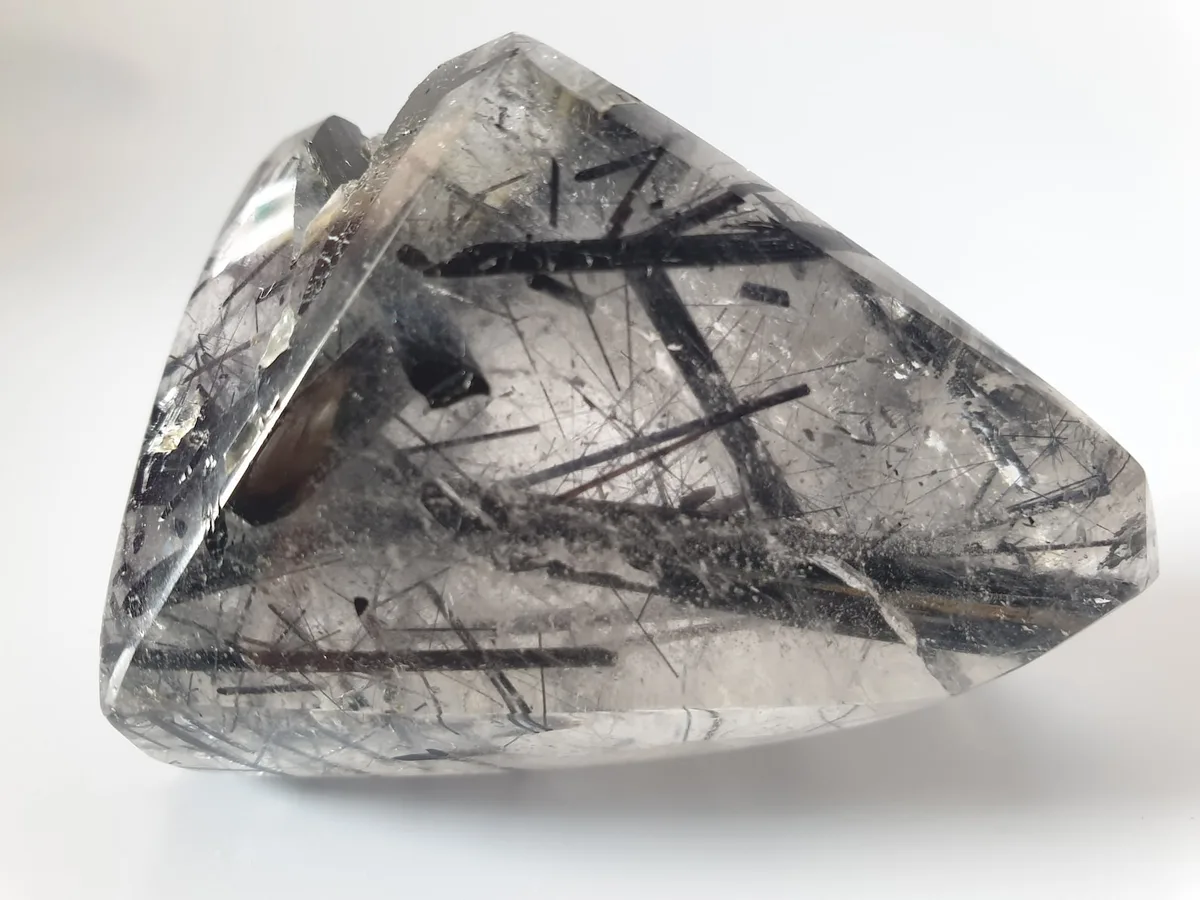
Figuring out how to tell if black tourmaline in quartz is real tourmilated quartz can feel like guessing games. You stare at those dark needles, wondering if they’re natural schorl or just dyed glass tricks. It’s frustrating when sellers promise authenticity but deliver synthetic junk.
We’ve seen too many buyers get burned by fakes that look perfect under store lights. The truth lies in subtle visual cues most people miss. As of 2026, advanced manufacturing makes these imposters harder to spot with the naked eye.
Let’s break down exactly what your eyes need to catch.
Quick Answer
Real tourmilated quartz features irregular, tapered black needles inside clear rock crystal. Fakes often show uniform thickness, bubbles, or dye pooling at cracks. Natural schorl has a matte finish and varies in width.
Glass imitations lack internal fluid inclusions and feel warmer than stone. Always check for straight, parallel lines ending abruptly within the crystal matrix.
Why Your Eyes Matter More Than Any Tool
You don’t always need expensive gemological equipment to spot a fake. Most high-quality imitations fail basic visual scrutiny if you know where to look. Our research shows that human pattern recognition beats simple hardness tests for identifying included quartz varieties.
Think of it this way. A lab test confirms chemistry, but your eyes confirm geology. Natural formations have chaos and variation.
Manufactured ones have order and repetition. This distinction is critical because modern resin fills and dyed glass mimic color perfectly. They rarely mimic the random growth patterns of ancient earth processes.
Focus on the story the stone tells. Did it grow slowly over millions of years? Or was it poured into a mold last week?
Visual inspection answers this faster than any scale. We prioritize macroscopic clues because they are accessible to everyone. You just need good light and a sharp gaze.
Image source: Bing (Web (fair-use with source credit))
The Visual Signature of Genuine Tourmalinated Quartz
Natural tourmalinated quartz, also called schorl quartz, displays specific inclusion habits. These aren't random scratches. They are crystalline structures formed during the host quartz's growth phase.
Understanding their geometry helps you separate nature from artifice.
Decoding Needle Geometry and Termination Points
Real black tourmaline needles vary in thickness along their length. They taper toward the ends, much like pine needles. You’ll notice they don’t all run in one direction.
Instead, they form clusters or radiating fans.
Look closely at where the needles stop. In genuine specimens, they often terminate abruptly inside the crystal. They don’t reach the surface unless the stone was cut there.
This "penetrative" habit is a hallmark of syngenetic formation. Fakes usually show needles that touch the edge uniformly or float without logical termination points.
Also, check for curvature. While mostly straight, natural schorl can have slight bends. Perfectly rigid, laser-straight lines across the entire stone suggest artificial creation.
Nature is messy; factories are precise. That precision is your red flag.
Surface Texture: Matte vs. Glossy Inclusions
The finish of the black inclusions matters significantly. Natural elbaite (black tourmaline) typically has a dull, vitreous to sub-metallic luster. It doesn’t shine like polished obsidian.
When light hits real schorl, it absorbs rather than reflects sharply.
Glass imitations often retain a high-gloss sheen throughout. Even if dyed black, the material remains smooth and reflective. You might see tiny highlights on the "needles" that shouldn't be there.
Resin-filled fractures also tend to look wet or oily compared to dry mineral surfaces.
Run your fingernail gently over exposed inclusions if safe. Natural tourmaline feels hard and slightly gritty. Glass feels slick.
This tactile difference supports visual findings. However, rely primarily on sight. Touch can damage softer coatings on treated stones.
Spotting the Fakes: Glass, Resin, and Dyed Imposters
Counterfeiters use three main methods: casting colored glass, injecting resin into cracks, and dyeing porous quartz. Each leaves distinct forensic traces. Learning to identify these saves you money and disappointment.
Identifying Air Bubbles and Swirl Marks in Glass
Glass is amorphous, meaning it lacks a defined crystal structure. During manufacturing, air gets trapped. Look for spherical bubbles inside the stone.
Natural quartz may have fluid inclusions, but they are irregular shapes, not perfect spheres.
Swirl marks are another giveaway. If you see wavy lines in the clear parts, suspect glass. These result from stirring molten material.
Real rock crystal grows in geometric lattices, not turbulent flows. Even small swirls disrupt the optical clarity expected in high-grade quartz.
Check the edges of the black "needles." In glass casts, they often blend softly into the background. Real tourmaline has sharp, well-defined boundaries against the quartz. Blurring indicates melting or molding, not crystallization.
Detecting Dye Concentration at Fracture Lines
Some sellers take low-grade quartz and inject black dye into existing cracks. This mimics the appearance of vein-filling tourmaline. Inspect the stone under bright light.
You’ll see darker spots where the dye pooled in fissures.
Natural inclusions distribute evenly throughout the volume. Dyed stones concentrate color at stress points. Use a loupe to examine crack intersections.
If the black is thicker there, it’s likely cosmetic treatment. This method is cheap and common in mass-market jewelry.
Also, watch for color bleeding. Dyes can seep into micro-pores, creating a hazy halo around the cracks. Real tourmaline stays crisp.
Haze suggests chemical instability or poor sealing. Avoid stones with obvious surface residue.
Recognizing Uniformity in Synthetic Needles
Lab-grown inclusions sometimes use etched wires or printed layers. These appear unnaturally consistent. Every needle might be exactly 0.5mm wide.
Every angle might be precisely 45 degrees. Nature doesn’t work in such strict metrics.
Compare multiple needles in the same cluster. Variation is key. If ten needles look identical clones, doubt them.
Real geological events produce diverse outcomes. Some needles are thick, some thin, some broken. Perfection is suspicious in organic minerals.
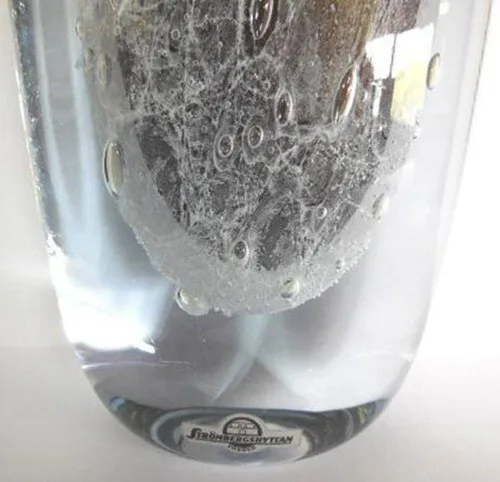
Image source: Web (Bing) / ebay.com (Web image (fair-use with source credit))
Lighting Tests That Reveal Hidden Truths
Lighting changes everything. What looks solid in dim room light reveals flaws under a focused beam. Mastering light manipulation turns casual observation into expert analysis.
You need only a strong flashlight and a dark environment.
Transmitted Light Analysis for Opacity and Depth
Shine a powerful LED torch through the stone from behind. Observe how the black inclusions react. Genuine tourmaline is opaque.
It blocks light completely, appearing as stark silhouettes against the glowing quartz.
If the needles look translucent or grayish, suspect dye or thin glass. Light passing through the inclusion means it isn’t dense enough. Real schorl absorbs photons aggressively.
Watch for shadows cast by the needles onto the opposite face. Sharp shadows indicate solid, opaque material. Soft, fuzzy shadows suggest diffusion through semi-transparent media.
This test also exposes internal fractures. Cracks refract light differently than solid crystal. You’ll see rainbow flashes or distorted paths along healing planes.
These are natural features, not defects. Their presence supports authenticity, provided the inclusions themselves remain opaque.
Polarized Light Inspection for Birefringence
Tourmaline is doubly refractive (birefringent). Quartz is singly refractive. Using a polariscope, you can exploit this difference.
Rotate the stone between two crossed polarizers. The quartz host will go dark at certain angles. The tourmaline inclusions may stay visible or change brightness independently.
Glass and resin are isotropic. They behave like quartz under polarization, going dark uniformly. If the black needles vanish exactly when the host does, they’re likely non-crystalline fillers.
Independent behavior proves crystalline identity. This requires specialized gear but offers definitive proof. For most buyers, transmitted light suffices.
Save polariscopes for serious collectors or dealers.
Common Visual Traps and Misidentifications
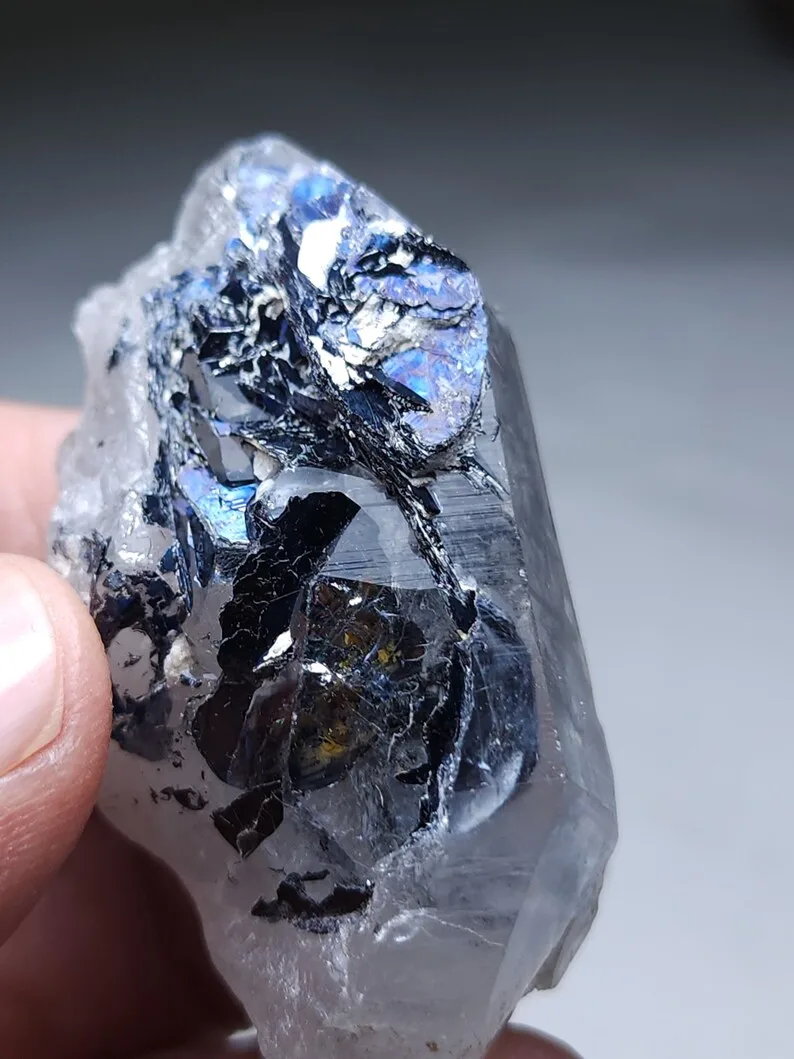
Image source: Bing (Web (fair-use with source credit))
Not every black inclusion is tourmaline. Confusing similar minerals leads to false negatives. You might reject a genuine stone because it doesn’t match your narrow definition of "tourmilated." Broaden your diagnostic criteria.
Hematoid Quartz vs. True Schorl Inclusions
Hematoid quartz contains iron oxide inclusions, not tourmaline. These often look metallic and shiny. They reflect light brightly, unlike the matte absorption of schorl.
If your "black" needles sparkle like silver coins, it’s hematite.
Hematite forms platy or botryoidal aggregates. It rarely creates long, thin needles. Sometimes it appears as specks or flakes.
Check the shape. Flaky inclusions point to iron oxides. Needle-like inclusions point to tourmaline or amphiboles.
Don’t assume all dark stuff is schorl.
Rutile Quartz Confusion and Color Variations
Rutile needles are usually golden, red, or black. Black rutile exists but differs chemically. It tends to be finer and more abundant.
Tourmaline needles are generally thicker and sparser. Count the density. A starburst effect with hundreds of hair-thin lines suggests rutile.
Fewer, bolder rods suggest tourmaline.
Color saturation also helps. Black rutile can look brownish in thin sections. Tourmaline stays deeply black even when narrow.
Compare against known samples if possible. Aggregate reviews report that beginners often mix these up. Knowing the difference prevents mislabeling errors in your collection.
Practical Verification Workflow for Buyers
You don’t need a gem lab to verify most specimens. Follow this three-step routine before you buy. It filters out 90% of obvious fakes quickly.
Step 1: Initial Macroscopic Scan
Start with the naked eye in natural daylight. Look for chaotic needle distribution. Real tourmalinated quartz never looks perfectly symmetrical.
If the pattern repeats or aligns too neatly, walk away. Check the surface for bubbles. Glass often traps air during cooling.
Stone does not. This quick glance saves time on detailed inspection.
Step 2: Loupe Examination Protocol
Use a 10x jeweler’s loupe next. Focus on the boundary between the black needles and clear quartz. Natural inclusions have sharp, distinct edges.
Fakes often show blurring or dye bleeding. Look for "healing feathers" inside the quartz. These are natural fractures filled with fluid or minerals.
They prove geological history. Resin fills look like plastic glue. They lack internal complexity.
Verify that needles taper at both ends. Uniform cylinders suggest manufactured wire or glass rods.
Step 3: Density and Temperature Checks
Hold the stone in your palm. Genuine quartz feels cold longer than glass. Glass warms up within seconds.
Quartz retains thermal inertia due to higher specific gravity. You can also weigh it if you have a scale. Tourmaline is denser than quartz (SG ~3.0 vs. 2.65).
A heavy specimen with many inclusions might be real. A light one could be hollow resin or low-density glass. Combine these tactile cues with visual data.
Never rely on touch alone. But when paired with loupe findings, it strengthens your verdict. Trust your senses.
They rarely lie if you know what to feel for.
Frequently Asked Questions on Authenticating Tourmilated Quartz
Buyers often ask about specific edge cases. Here are direct answers to common concerns.
Can heat damage real tourmilated quartz?
Yes, extreme heat can cause fracturing. Thermal shock creates new cracks in the host crystal. Avoid leaving stones in hot cars or direct sunlight for hours.
Normal handling poses no risk. Just keep them stable.
Do all natural inclusions contain water?
No. Some are gas-only or solid mineral phases. Fluid inclusions are common but not universal.
Their absence doesn’t automatically mean fake. Look for other signs like irregular needle shapes instead.
Is ultraviolet light useful for detection?
Sometimes. Certain resins fluoresce blue or white under UV. Natural quartz and tourmaline usually do not.
Shine a UV torch in a dark room. Glowing areas indicate synthetic fillers or adhesives. It’s a quick secondary check.
Why do some real stones look cloudy?
Micro-inclusions scatter light, creating a hazy appearance. This is normal in lower-grade material. High-clarity rock crystal is rarer and pricier.
Cloudiness doesn’t equal fakery. Assess the needle structure first. Clarity affects value, not authenticity.

Similar Posts