Synthetic vs Natural Ruby: How to Spot the Difference
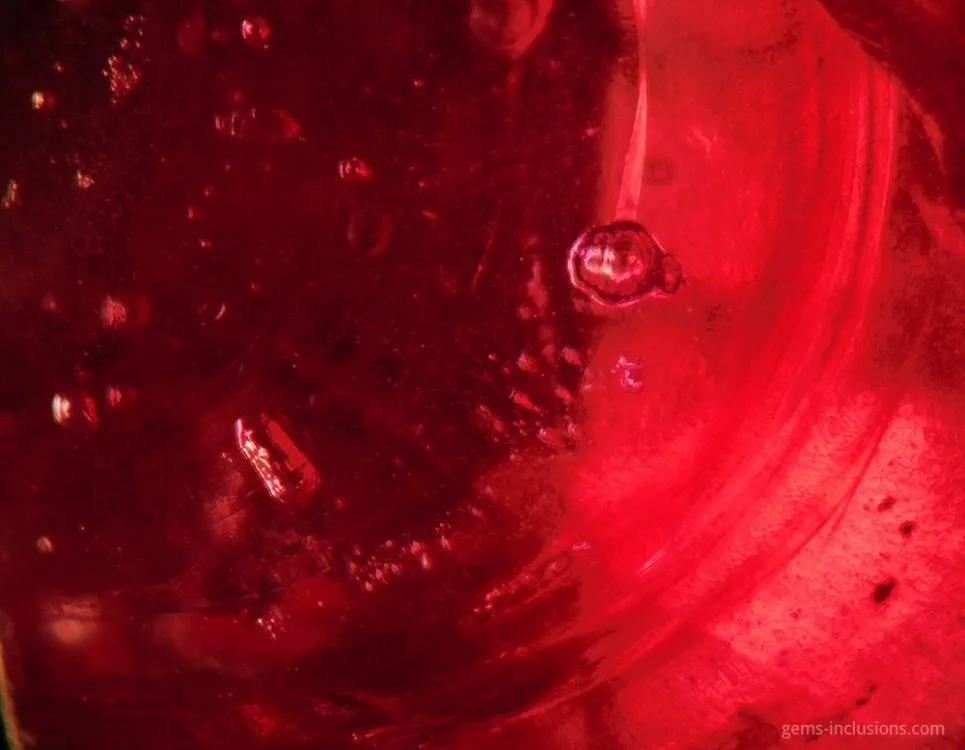
Figuring out how to identify synthetic lab created ruby vs natural ruby is less about chemistry and more about geometry. Both stones are pure corundum, sharing the same hardness and refractive index. The difference lies in their history.
Nature grows crystals slowly under pressure, creating straight lines. Labs grow them quickly, leaving curved scars.
You can’t rely on naked-eye inspection for this distinction. As of 2026, high-quality flame-fusion synthetics mimic natural color zoning so well that even trained gemologists need magnification. We’ve seen cases where a $50 stone was sold as a $5,000 natural because the seller skipped the microscope step.
Let’s break down exactly what you’re looking for.
Quick Answer
To identify a synthetic ruby, look for curved growth bands under magnification. Natural rubies display straight angular growth zones. Use a 10x loupe or microscope to spot these patterns.
Check for gas bubbles in synthetics versus fluid inclusions in naturals. If the stone is perfectly clean with no inclusions, suspect it is lab-created. Always verify with a certified lab report for high-value purchases.
Why You Can’t Trust Your Eyes Alone (And What Actually Works)
Your eyes lie to you when it comes to gemstones. Modern manufacturing techniques produce rubies that are chemically identical to their earth-mined counterparts. They have the same chromium content, which gives them that red hue.
They reflect light the same way. To the untrained eye, a Verneuil-process ruby looks just like a Burmese ruby.
The problem isn’t quality. It’s origin. A natural ruby carries geological history.
It formed over millions of years in metamorphic rock. This slow process creates specific internal fingerprints. Lab-grown rubies form in minutes or hours.
This rapid crystallization leaves behind distinct structural anomalies. These anomalies are invisible without help.
We rely on magnification to reveal these hidden clues. A standard jeweler’s loupe offers 10x zoom. This is enough to catch obvious flaws like large gas bubbles.
But subtle growth structures often require 30x to 60x magnification. Without these tools, you’re guessing. And guessing costs money.
Don’t assume "clean" means "natural." In fact, perfect clarity is a red flag. Natural gems almost always contain imperfections. These are called inclusions.
They are nature’s signature. Synthetics are engineered for perfection. While they aren't flawless, their flaws look different.
Understanding this visual language is your first defense against misrepresentation.
The One Visual Test That Separates 90% of Synthetics: Curved vs. Straight Growth Lines
Growth lines are the single most reliable indicator for most buyers. Think of them like tree rings. They show how the crystal expanded layer by layer.
The shape of these layers tells you where the stone came from.
Natural rubies grow in a hexagonal prism structure. The layers stack neatly on top of each other. Under a microscope, these appear as straight, parallel lines.
Sometimes they intersect at sharp angles. This geometric precision reflects the stable, slow environment of the Earth’s crust.
Synthetic rubies made via the Verneuil (flame fusion) method tell a different story. Molten droplets fall onto a seed crystal. They solidify in rounded, concentric layers.
Imagine dropping water into a pond. The ripples spread outward in curves. These are curved growth striations.
They arc across the stone’s interior.
This distinction is critical because it applies to the most common synthetics on the market. Flame-fusion production is cheap and fast. It dominates the low-end jewelry sector.
If you see curved lines, the stone is man-made. There are rare exceptions, but for practical purposes, this rule holds up.
Other methods like Czochralski pulling also leave marks. These often show straight lines too, but they come with other defects. We’ll cover those later.
For now, master the curve. It’s your quickest filter.
How to Spot Verneuil “Curved Striations” Under a Loupe
Finding these lines requires technique, not just luck. Hold the stone steady. Shine a strong, focused light source through the side of the gem.
This is called darkfield illumination. It helps highlight internal structures against a dark background.
Look for fine, wavy lines running parallel to the stone’s surface. They shouldn’t be perfectly straight. They should bow gently.
Rotate the stone slowly. The lines will shift perspective. In a natural stone, straight lines stay rigid relative to the facets.
In a synthetic, the curves distort slightly as you turn it.
Use a 10x loupe for initial screening. If you see obvious arcs, put the stone down. It’s likely synthetic.
However, some high-grade synthetics have very faint curves. You might need a stereo microscope set to 20x or higher. Focus on the table facet area.
This is often where the curvature is most visible due to the viewing angle.
Don’t confuse scratches with growth lines. Scratches sit on the surface. Growth lines exist inside the crystal.
Move your focus plane deeper into the stone. If the lines disappear when you focus on the surface, they were scratches. If they remain while you dig deeper, they are structural.
Identifying Flux and Hydrothermal Signatures (The Tricky Ones)
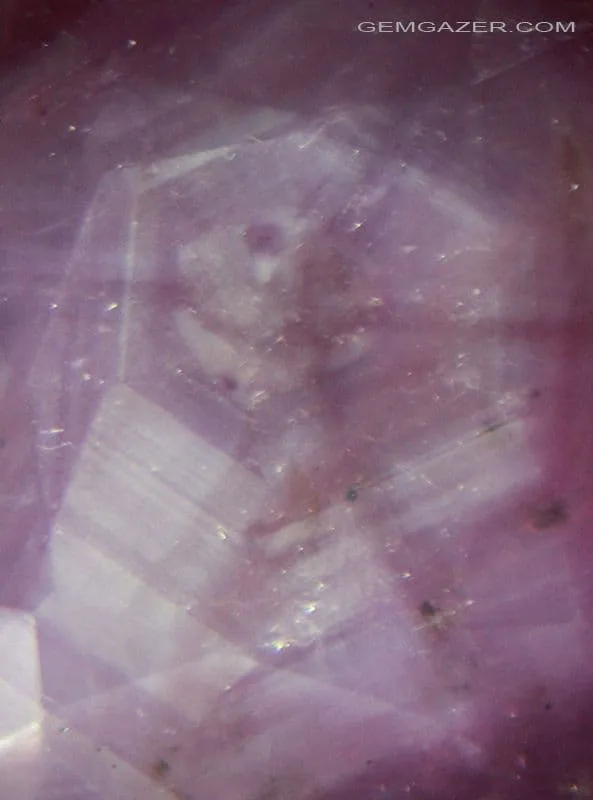
Not all synthetics use fire. Flux-grown and hydrothermal rubies cool much slower than Verneuil stones. Their growth structures mimic naturals more closely.
You won’t see dramatic curved bands here. Instead, look for residual flux.
Flux-grown rubies are melted in a solvent. When cooled, glassy remnants of this solvent get trapped inside. These look like metallic splashes or cloudy patches.
They often have a shimmering, iridescent quality. Naturals don’t have this artificial residue.
Hydrothermal rubies grow in pressurized water solutions. They may contain tiny, negative-shaped crystals. These look like hollow spaces in the shape of the host crystal.
They are extremely difficult to distinguish from natural fluid inclusions without advanced spectroscopy.
For these types, visual ID alone is risky. Aggregate reviews indicate that even experts struggle with small hydrothermal stones. If you suspect one of these methods, do not rely solely on a loupe.
Look for uniform color distribution. Naturals often have color zoning. Synthetics tend to be evenly colored throughout.
Also, check for seeds. Pulling processes leave a small scar where the crystal detached from the seed rod. This appears as a flat, polished spot inside the rough stone.
It’s a dead giveaway for manufactured origins.
Essential Tools for Home Inspection: From $20 Loupes to Microscopes
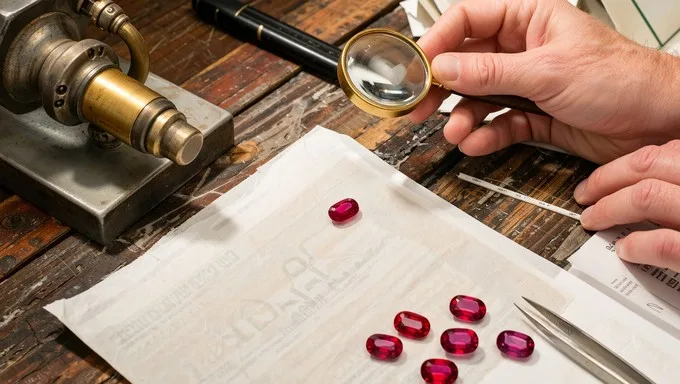
You don’t need a laboratory setup to start. But you do need better than your phone camera. Here is the tiered approach we recommend for serious collectors and retailers.
| Tool | Magnification | Best For | Limitation |
|---|---|---|---|
| Jeweler’s Loupe | 10x | Initial screening, large inclusions | Misses fine growth details |
| Stereo Microscope | 20x–60x | Definitive visual ID, growth lines | Requires power and space |
| Polariscope | N/A | Detecting strain patterns | Specialized, expensive |
| UV Lamp | N/A | Fluorescence comparison | Not definitive on its own |
Start with a triplet loupe. This has three lenses to correct distortion. A cheap single-lens loupe warps the image, making straight lines look curved.
Avoid this error. Ensure the loupe has a built-in LED light. External lights create glare that hides internal features.
If you’re buying regularly, invest in a entry-level stereo microscope. Brands like AmScope offer models under $200. Set it to 30x magnification.
Use fiber-optic illuminators to backlight the stone. This setup reveals the subtle differences between natural healing fractures and synthetic voids.
Don’t forget lighting temperature. Use daylight-balanced LEDs (around 5000K). Warm yellow bulbs alter color perception.
You might mistake a pale synthetic for a saturated natural under incandescent light. Consistency matters. Train your eye under the same conditions every time.
Common Visual Traps: When Perfect Clarity Means Fake Value
New buyers often equate cleanliness with quality. They think a flawless ruby is a treasure. In reality, a completely inclusion-free ruby is statistically improbable in nature.
It is highly probable in a lab.
Natural rubies form under chaotic geological stress. They trap dirt, cracks, and other minerals. These inclusions prove authenticity.
A stone with zero visible flaws under 10x magnification warrants suspicion. It doesn’t mean it’s fake. But it means you need to look harder.
Another trap is color saturation. Synthetics are often vividly red. They lack the slight brownish or purplish undertones found in many naturals.
Don’t let vibrant color fool you. Check the tone. If it’s uniformly bright pink-red, inspect the growth lines immediately.
Beware of "eye-clean" claims. Sellers use this term loosely. It usually means no flaws are visible from six inches away.
It does not mean the stone is free of microscopic evidence. Always demand to see the stone under magnification before trusting verbal assurances.
Finally, ignore thermal conductivity testers. These devices work for diamonds. They measure heat dispersion.
Rubies conduct heat differently. A diamond tester will give false negatives or positives for corundum. Stick to optical inspection methods.
Quick Reference Guide: Natural Ruby Inclusions vs. Lab-Created Artifacts
Use this cheat sheet during your inspection. Match what you see to the column below. Remember, context is key.
One feature rarely confirms identity alone. Look for combinations.
| Feature | Natural Ruby Indicator | Synthetic Ruby Indicator |
|---|---|---|
| Growth Structure | Straight, angular lines | Curved, concentric bands (Verneuil) |
| Inclusions | Rutile silk, feather fractures | Gas bubbles, flux residue |
| Color Distribution | Zoned, uneven | Uniform, consistent |
| Surface | Minor polishing marks possible | Often overly perfect polish |
| UV Reaction | Weak to moderate fluorescence | Strong, sometimes unnatural glow |
Gas bubbles are spherical or teardrop-shaped. They form when air gets trapped in molten material. Naturals contain liquid or solid inclusions.
These look irregular. If you see perfect spheres, suspect synthesis.
Rutile silk consists of fine needle-like crystals. It creates a velvety appearance. This is rare in synthetics.
If a stone has no silk and no obvious flaws, check the growth lines again.
Per GIA guidelines, professional grading is required for legal certainty. Visual ID is a screening tool. It saves time.
It filters out obvious fakes. It does not replace certification for high-value items.
When to Stop Looking and Start Paying: The Legal and Financial Safety Net
Sometimes, your loupe isn’t enough. If the stone is valued over $500, visual inspection carries too much risk. You need paper trails.
A GIA or SSEF report provides definitive proof of origin. These labs use advanced spectroscopy and microscopy that you simply can’t replicate at home.
Consider the cost-benefit ratio here. A full lab report typically runs between $150 and $300. Compare that to the potential loss of thousands if you buy a synthetic as natural.
The math favors certification for anything significant. It’s insurance against fraud.
Legal compliance also plays a role. The FTC requires clear disclosure of lab-grown status in marketing. Selling a synthetic without labeling it violates consumer protection laws.
If you’re reselling, this liability falls on you. Proper documentation protects your reputation and wallet.
Don’t skip this step for estate jewelry or pawn shop finds. Provenance is often missing in these channels. That’s exactly where misrepresentation happens most.
Get it graded before you commit funds. It turns a gamble into an investment.
FAQs
Can a diamond tester identify rubies?
No. Diamond testers measure thermal conductivity. Rubies are corundum, which conducts heat differently.
The device will likely read "false" or give inconsistent results. Never rely on electronic testers for colored gemstones. Stick to optical methods like loupes and microscopes for accurate identification.
Do all synthetic rubies have curved lines?
Most Verneuil synthetics do. However, flux-grown and hydrothermal varieties may show straighter growth patterns. These mimic naturals more closely.
This makes visual ID harder. Always check for other signs like flux residue or uniform color zoning. When in doubt, send it to a certified laboratory for testing.
Is a flawless ruby always fake?
Not necessarily, but it’s suspicious. Natural rubies almost always contain some inclusions. A completely clean stone under 10x magnification raises red flags.
High-quality naturals exist, but they are rare and expensive. Assume any "perfect" stone is synthetic until proven otherwise by a reputable gemological lab report.
How does UV light help distinguish them?
Both natural and synthetic rubies fluoresce red under ultraviolet light due to chromium. However, the intensity can vary. Some synthetics glow brighter or more uniformly.
This test alone isn’t conclusive. Use it as a secondary clue alongside growth structure analysis. Never base a final decision solely on fluorescence response.

Similar Posts